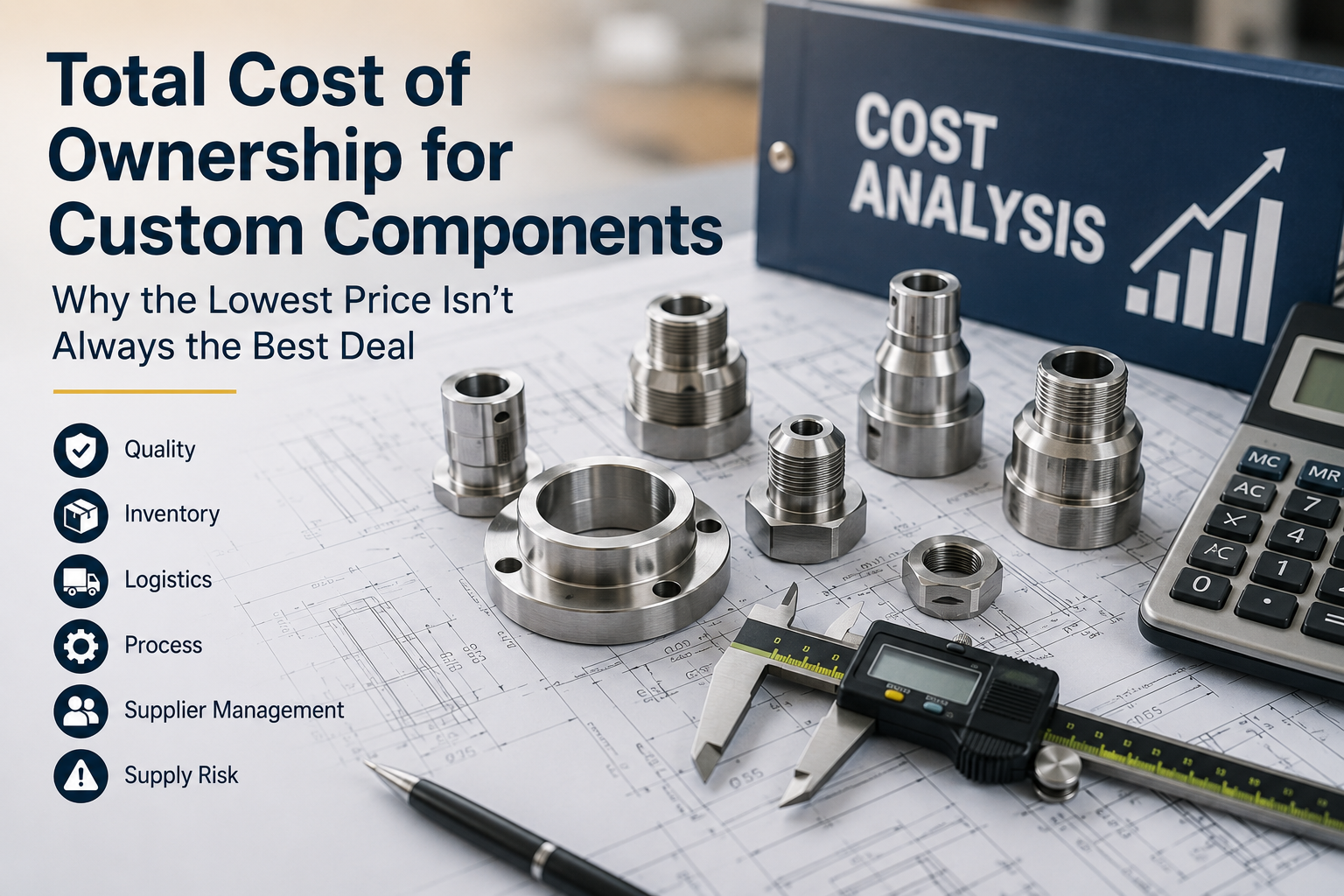






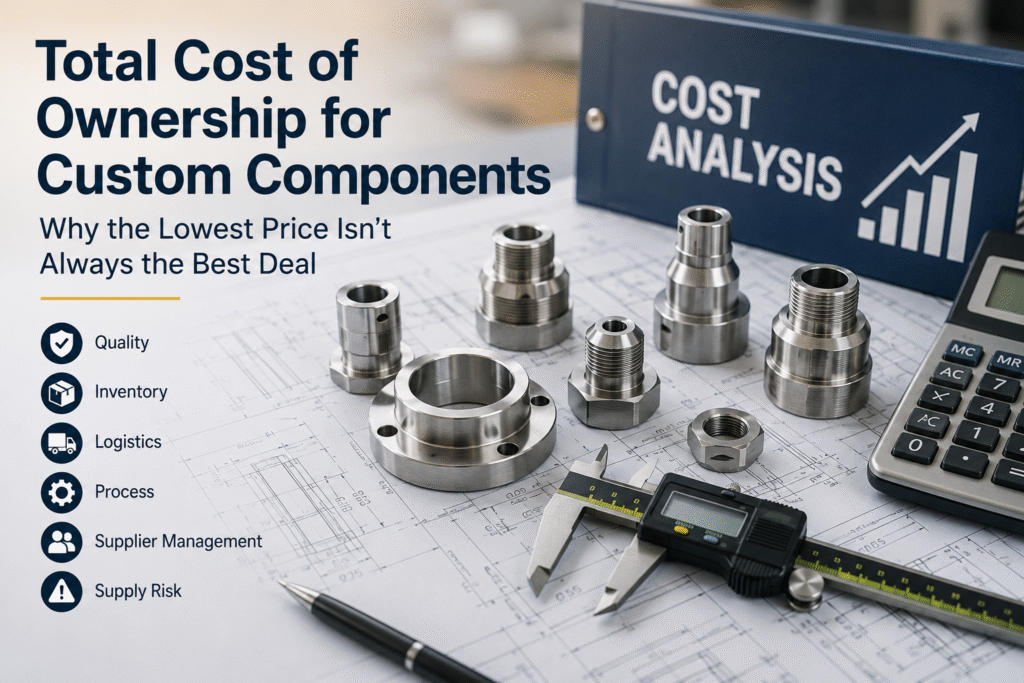
Total Cost of Ownership for Custom Components is an important concept when sourcing drawing-based or custom-made parts because the lowest unit price does not always mean the lowest overall cost. It provides a broader way to evaluate sourcing decisions by considering purchase price together with quality, inventory, logistics, manufacturing, administration, and supply risk.
For distributors and procurement teams, understanding Total Cost of Ownership for Custom Components helps reveal costs that may not appear on the original quotation. These costs can accumulate throughout production, inspection, delivery, inventory management, and after-sales problem solving, making supplier selection about much more than price alone.
Total Cost of Ownership for Custom Components Goes Beyond Unit Price
Total Cost of Ownership (TCO) evaluates a purchasing decision based on its complete cost rather than purchase price alone. For custom components, the concept can be simplified as:
TCO = Purchase Cost + Quality Cost + Inventory Cost + Logistics Cost + Administrative Cost + Supply Risk
Standard products usually have predefined specifications, while custom-made components may involve different materials, tolerances, heat treatments, surface finishes, inspection requirements, and packaging. Even a small specification change can affect the manufacturing process, lead time, quality risk, and final cost.
Quality Problems Can Quickly Eliminate Unit Price Savings
Imagine Supplier A offers a unit price 5% lower than Supplier B. If the parts regularly require additional inspection, sorting, or rework after arrival, those initial savings can quickly disappear. If a problem is discovered during assembly, the cost can increase further through production interruptions, returns, customer complaints, and emergency replacement shipments.
The
American Society for Quality (ASQ)
describes quality costs in terms of prevention, appraisal, internal failure, and external failure costs. This demonstrates why the true cost of a quality issue can extend far beyond the value of the defective component itself.
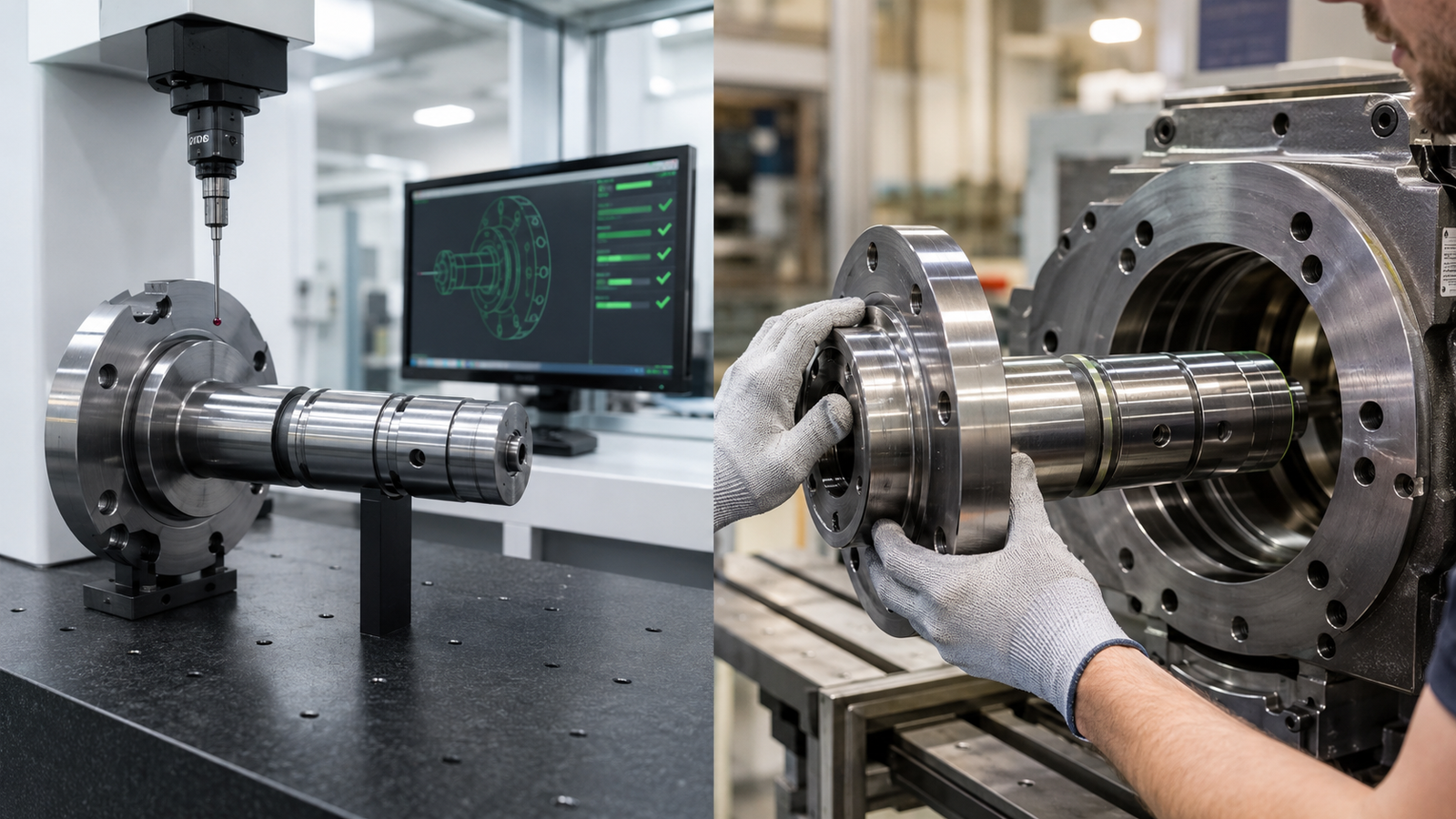
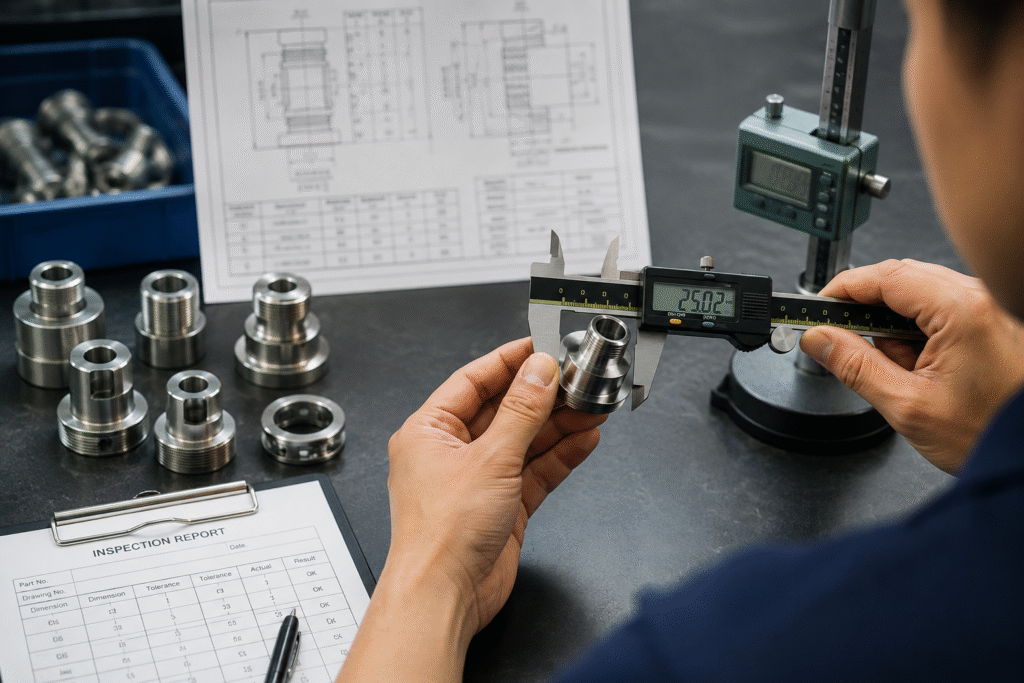
Quality is therefore a major factor when evaluating Total Cost of Ownership for Custom Components. For custom-made components, quality management should not depend only on final inspection. At Excel Components, quality control starts with drawing and specification review and continues through in-process dimensional control and final inspection. Appropriate inspection methods are selected according to project requirements, helping identify potential issues before shipment and reducing sorting, rework, and complaint-handling costs.
A Lower Unit Price Can Create Higher Inventory Costs
A larger MOQ may help reduce the unit price, but excess inventory ties up working capital and requires warehouse space. If demand changes, drawings are revised, or a project ends, remaining inventory may eventually become obsolete.
Buyers should therefore consider production quantities, demand forecasts, and delivery arrangements together with price. Blanket orders, scheduled releases, partial deliveries, or consolidated shipments can sometimes reduce overall purchasing costs more effectively than simply negotiating a lower unit price.
Choosing the Right Manufacturing Process Can Reduce Long-Term Costs
Selecting the right manufacturing method can significantly influence Total Cost of Ownership for Custom Components. The cost of a custom component is closely connected to how it is manufactured, including material utilization, production efficiency, tooling, and secondary operations.
Depending on material, dimensions, tolerances, order volume, and application requirements, the most suitable manufacturing method can vary significantly. A process that works well for a small quantity may not necessarily be the most economical solution for mass production.
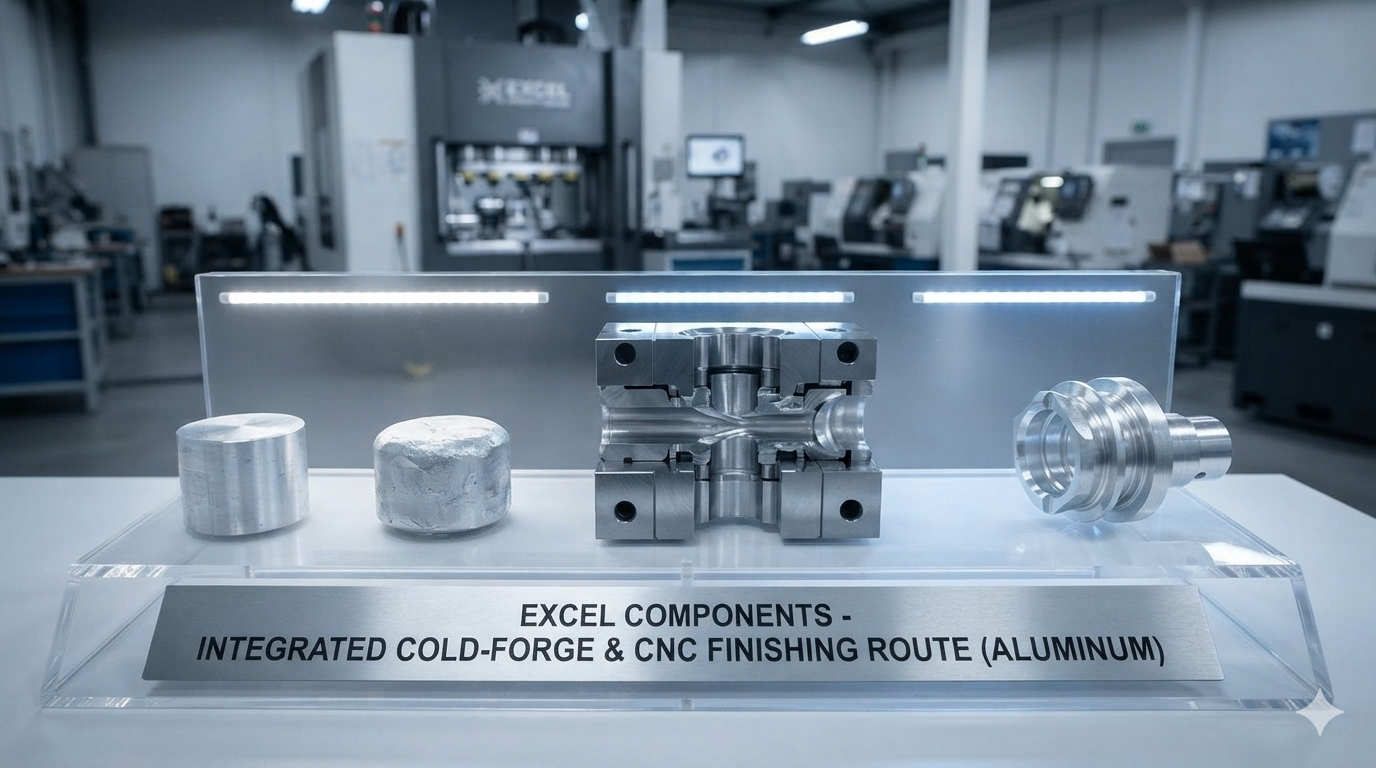
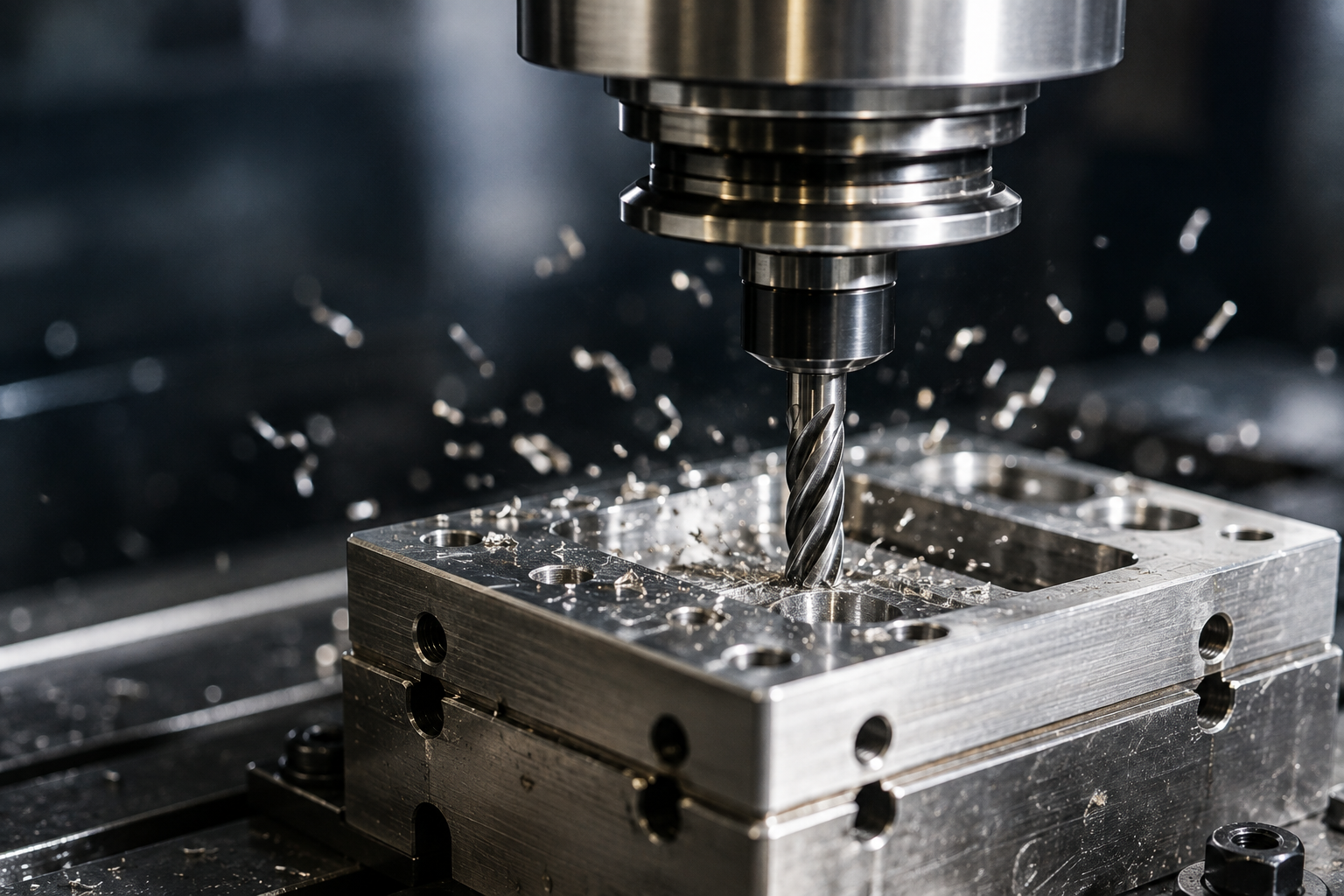
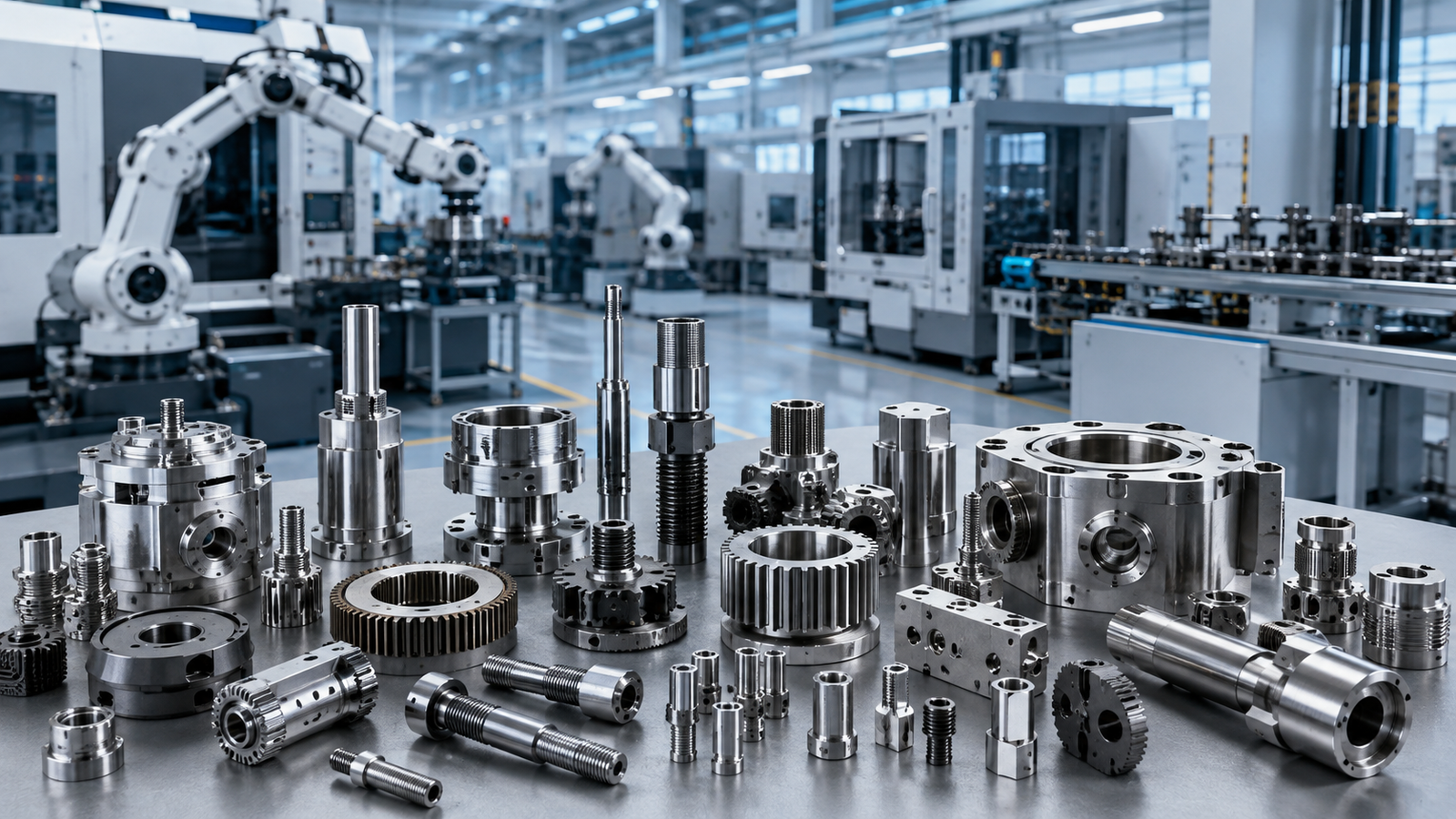
Excel Components works with multiple manufacturing processes, including CNC machining, turning, cold forging, and stamping, together with heat treatment, surface finishing, and other secondary operations. Based on the drawing, material, quantity, tolerances, and quality requirements, we can evaluate a suitable manufacturing approach rather than applying the same process to every project.
For distributors sourcing different types of custom components, this capability is not simply about producing a wider range of products. It can also reduce the need to search for and manage separate suppliers for different processes while helping balance cost, quality, and manufacturing efficiency.
Unreliable Lead Times Can Turn Into Expensive Emergency Freight
The cost difference between planned ocean freight and an unexpected air or express shipment can be significant. If production delays create an urgent shortage, a single emergency shipment may eliminate months of savings achieved through a slightly lower unit price.
Delivery reliability is another important part of Total Cost of Ownership for Custom Components. When suppliers communicate production status early, identify potential delays, and provide realistic shipment options, procurement teams have more time to adjust inventory levels and select cost-effective transportation.
Emails, Follow-Ups, and Repeated Confirmations Are Costs Too
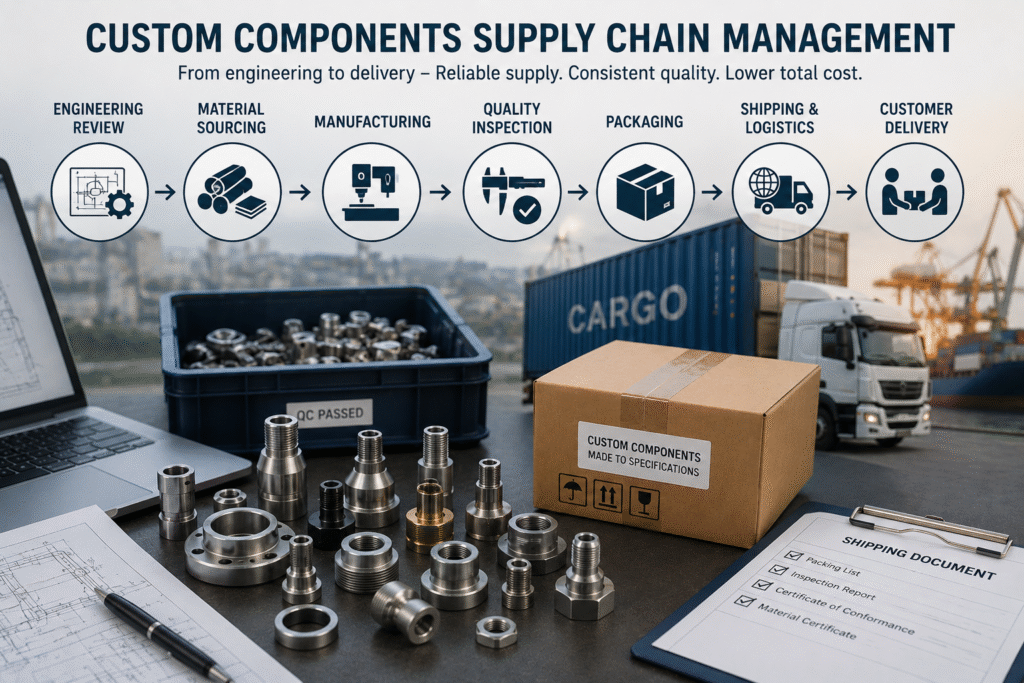
RFQ clarification, drawing reviews, production follow-ups, quality documentation, shipment coordination, and complaint handling all require time. A supplier that needs constant follow-up creates an administrative burden that rarely appears on the quotation but still contributes to the total sourcing cost.
Supplier management should also be considered when calculating Total Cost of Ownership for Custom Components. For drawing-based parts, confirming materials, tolerances, surface treatments, heat treatments, and inspection methods before mass production is especially important. Working with one supplier that can coordinate multiple processes, quality requirements, and secondary operations can reduce communication time and the administrative cost of managing multiple suppliers.
Sometimes the Most Expensive Component Is the One You Don’t Have
When a custom component cannot be delivered on time, the impact can extend far beyond one purchase order. For distributors, a shortage may affect the end customer’s production schedule and potentially reduce confidence in their ability to provide reliable supply.
Supplier evaluation should therefore consider production capacity, material availability, process stability, lead-time management, and the ability to respond when unexpected problems occur. These factors may not have an obvious value on a quotation, but they can significantly reduce long-term supply risk.
Include These Hidden Costs When Comparing Suppliers
A practical TCO comparison should look beyond the quoted unit price and consider how each supplier performs throughout the complete sourcing cycle. The following areas can help procurement teams identify costs that are easily overlooked during the RFQ stage.
| Evaluation Area | What Unit Price May Hide | Impact on TCO |
|---|---|---|
| Quality | Sorting, rework, returns, complaints | Higher quality and administrative costs |
| MOQ | Excess inventory and tied-up capital | Higher holding and obsolescence risk |
| Manufacturing Process | Material waste and processing efficiency | Higher long-term unit costs |
| Lead Time | Emergency freight and production shortages | Higher logistics and supply costs |
| Supplier Management | Emails, follow-ups, and documentation | Higher internal administrative costs |
Consistent Quality Management Helps Lower Long-Term TCO
The
ISO 9001 Quality Management System
emphasizes process management, monitoring, performance evaluation, and continual improvement. These principles are closely related to TCO because stable and controlled processes can help reduce variation and the costs associated with failures.
At Excel Components, the value of quality goes beyond passing a final inspection. Our approach covers drawing review, production control, dimensional inspection, and final shipment checks, with inspection methods selected according to individual project requirements. More consistent quality means less time and cost spent on additional inspection, sorting, rework, and problem solving after delivery.
Distributors Create More Value When They Make Sourcing Easier
If competition is always based on “our price is lower,” customers can easily move to another supplier when an even lower quotation appears. Long-term value comes from helping customers manage quality, manufacturing, inventory, logistics, and supply so that the purchasing process becomes easier and more reliable.
This is also the role Excel Components aims to play in custom manufacturing. Through multiple manufacturing processes, drawing-based production, quality management, and coordination from production through shipment, we help customers reduce the complexity of managing different suppliers while balancing cost, quality, and supply reliability.
Ask These 6 Questions Before Your Next Custom Component RFQ
Before selecting a supplier based on price alone, procurement teams can use the following questions to evaluate the broader sourcing impact:
- Is the supplier’s quality consistent, or will additional sorting and inspection be required?
- Is the manufacturing process suitable for the material, volume, and tolerance requirements?
- Is the MOQ reasonable, or will it create unnecessary inventory?
- Is the lead time reliable, or are emergency shipments common?
- Can the supplier coordinate multiple processes, surface treatments, and quality requirements?
- Can the supplier respond quickly and provide solutions when problems occur?
The Best Quotation Reduces Both Cost and Supply Risk
The goal of Total Cost of Ownership for Custom Components is not simply to determine which supplier is a few cents cheaper. It is to identify which sourcing solution can provide reliable quality and supply while reducing the overall cost of purchasing, managing, inspecting, storing, and delivering custom-made components.
When the manufacturing process is appropriate, quality is consistent, delivery is reliable, and procurement teams spend less time managing multiple suppliers, hidden costs begin to decrease. This is why Total Cost of Ownership for Custom Components provides a more complete way to evaluate long-term sourcing value than unit price alone.
Looking Beyond the Unit Price?
Looking for a sourcing solution for your custom components? Excel Components can review your drawing, material, manufacturing process, quality requirements, surface treatment, packaging, and delivery needs to help identify a practical solution that balances cost, quality, and supply reliability.
Contact Our Engineering Team
and send us your drawing and requirements for evaluation.